Quick summary
Sumo hours at a glance
| Question | Answer |
|---|---|
| Show days | Daily, year-round (occasional private-event blackouts) |
| Start times | Several per day, varying by season — exact times load on the calendar above |
| Duration | About 2 hours including the chanko meal |
| Arrival | 15–20 minutes early; latecomers may lose the ring-challenge lottery window |
| Tournament hours | November basho: doors ~8:45, final bout ~18:00 (Japan Sumo Association timetable) |
| Best value slot | Early evening — the included meal replaces dinner |
Why don't we print fixed start times here? Because the operator adjusts them seasonally — a page that says "17:00 daily" will eventually lie to you. The availability calendar always shows the real, bookable times for your specific date; treat everything else (including screenshots on review sites) as historical.
Inside the two hours
How a sumo show is structured, minute by minute
Knowing the running order helps you decide when to eat, when to film, and when to put the phone down:
| Segment | Roughly | What happens |
|---|---|---|
| Doors & seating | −20 to 0 min | Check in, find your tier, order first drinks; the dohyō sits centre-room at arm's reach |
| Dance opening | 0–10 min | A traditional kimono dance performance opens the evening |
| History & rules | 10–30 min | The MC covers 1,500 years of sumo in English and Japanese — genuinely funny, genuinely informative |
| Technique demos | 30–55 min | Shiko stomps, splits, teppo, the do's-and-don'ts of the ring; chanko service begins |
| Exhibition bouts | 55–80 min | Best-of-three between former professionals — real speed, real impact |
| Ring challenge | 80–100 min | Volunteers (lottery if oversubscribed) try to move a rikishi; children handled gently, adults less so |
| Photos & farewell | 100–120 min | Group photo with the wrestlers, souvenir bags, framed print to take home |
Don't arrive late. The lottery for ring-challenge spots is drawn from guests present near the start. Arriving mid-show also means walking in front of an active dohyō — awkward at best.
Tournament timetable
November basho hours: a full day at the Kokusai Center
The Grand Sumo Tournament runs on a fundamentally different clock — one ticket covers roughly nine hours of wrestling. The Japan Sumo Association's typical daily rhythm in Fukuoka:
| Time (approx.) | What's on | Crowd level |
|---|---|---|
| 8:45 | Doors open; jonokuchi and jonidan divisions begin | Nearly empty — you can hear the wrestlers breathe |
| 11:00–14:00 | Sandanme and makushita — hungry young wrestlers fighting for promotion | Sparse; the connoisseur hours |
| ~14:15 | Jūryō dohyō-iri (ring-entering ceremony), then jūryō bouts | Filling; first great photo window |
| ~15:40 | Makuuchi dohyō-iri — the top division parades in keshō-mawashi aprons, then the yokozuna's own ceremony | Busy; second photo window |
| 16:10–17:55 | Top-division bouts, rank order ascending to the final match | Full house, loudest at the last three bouts |
| ~18:00 | Yumitori-shiki (bow-twirling ceremony) closes the day | Mass exit — linger five minutes and leave in comfort |
Times shift by a few minutes day to day depending on bout counts; the association publishes exact division start times on its official schedule. On the final day (senshūraku) the last stretch runs slightly earlier to fit the championship ceremony.
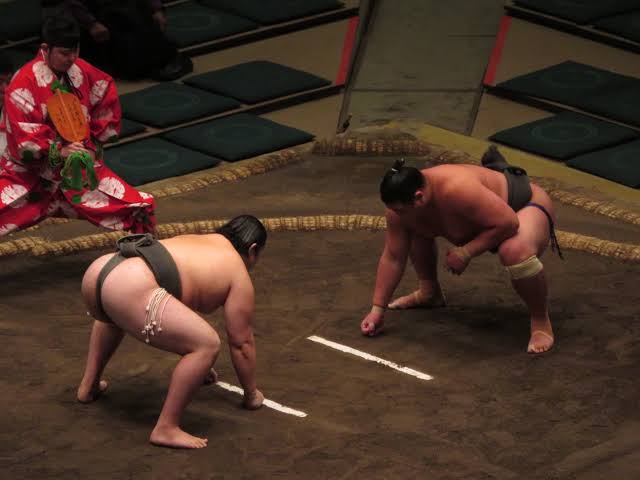
For what all these rituals mean — and why day 14 beats day 3 — read the basho guide. For seats and booking, the tournament tickets page.
Match your slot to your itinerary
Shows sell by time slot, and the popular ones close first. Check what's open on your dates before planning dinner around it.
Timing is everything
Which slot should you actually book?
- Travelling with kids: matinee. Quieter room, easier attention spans, and children still get full ring-challenge priority. Nap schedules survive.
- Date night or group evening: the early-evening show. The chanko is dinner, the crowd is livelier, and Asakusa's lantern-lit streets afterwards do half your evening planning for you.
- Tight itinerary: book the slot adjacent to your Sensō-ji visit — the temple and the show sit in the same district, killing transit time. Pair with an early-morning temple walk (crowd-free before 8:00) and you've done Asakusa properly in one day.
- November in Fukuoka: skip the show logic entirely and structure the day around the Kokusai Center — arrive by 14:00, stay to 18:00, dinner in Hakata after (see where to eat).
Seasonal notes
- Cherry-blossom season (late March–early April) and Golden Week (late April–early May): shows sell out days ahead. Book as soon as flights are fixed.
- Rainy June evenings are sneaky-busy — indoor activities absorb washed-out itineraries. Same advice.
- New Year: operating patterns can change around 29 Dec–3 Jan; trust only the calendar for those dates.
FAQ
Hours & schedule — quick answers
What time does the sumo show start?
Start times vary by date and season — several slots run most days. The booking calendar shows the exact times available for your date; that's the authoritative source.
How long does it last?
About two hours, meal included. With early arrival, budget two and a half.
Is it open every day?
Shows run daily year-round, with rare blackout dates for private events. No availability on your date usually means sold out or blocked — check adjacent days.
What are tournament hours in Fukuoka?
Roughly 8:45 doors to 18:00 final bout, every day for 15 days each November at the Fukuoka Kokusai Center. Top-division action runs from about 15:40.
Can I leave and re-enter?
At the show: it's a two-hour seated event — plan to stay. At the tournament: re-entry rules are set by the organiser and have historically been limited, so check the day's policy before stepping out.
When should I arrive?
Show: 15–20 minutes early. Tournament: by 14:00 to catch both ring-entering ceremonies, or 8:45 if you want the full nine-hour experience.
Your date decides everything
Open the calendar, check your dates, and lock a slot while the good times are still on the board.