The system
What a basho actually is
Professional sumo runs six honbasho a year: January, May and September in Tokyo; March in Osaka; July in Nagoya; November in Fukuoka. Each lasts exactly 15 days. Every wrestler fights once daily against a different opponent, and the best win-loss record in the makuuchi (top division) lifts the Emperor's Cup on the final Sunday — senshūraku.
What makes the system merciless, and gripping, is that everything rides on the record. A wrestler finishing 8–7 climbs the banzuke ranking; 7–8 falls. Careers rise and collapse over a single bout on day 15. When you buy a basho ticket, you're not watching exhibition — every match, even at 9 a.m. between teenagers, moves someone's life.
The Kyushu Basho has closed the sumo year in Fukuoka since 1957. It's the smallest-city basho with the most local flavour: November is when titles are mathematically decided, retirements are announced, and next year's storylines are seeded. Locals treat it as Hakata's biggest annual event after the summer Yamakasa festival.
| Quick summary | Detail |
|---|---|
| What | Kyushu Grand Sumo Tournament — the year's sixth and final honbasho |
| When | 15 days each November (2026: Nov 8–22, per the JSA calendar) |
| Where | Fukuoka Kokusai Center, Hakata waterfront |
| Tickets from | ~¥3,500–4,000 same-day tier (official channels); guided packages priced live |
| Book ahead? | Essential for weekends and days 13–15 |
| Time to allow | 14:00–18:00 minimum; full day for devotees |
Rituals decoded
Why four-second fights need six-minute ceremonies
The first-timer's surprise is how little wrestling a sumo day contains and how much theatre. Once you can read the theatre, it stops being waiting and becomes the show:
- Dohyō-iri. Each division's ring-entering parade in embroidered keshō-mawashi aprons — silk, gold thread, sponsor crests, some worth more than a car. The yokozuna then performs his own solo ceremony flanked by a sword-bearer and dew-sweeper.
- Salt. Wrestlers hurl handfuls before each bout to purify the ring — sumo kept its Shinto liturgy intact. Crowd favourites turn it into showmanship; watch for the big theatrical throws late in the day.
- Shikiri. The crouch-and-stare cycle, repeated up to the time limit (four minutes in the top division). It looks like stalling; it's psychological warfare with a clock.
- The tachiai. The synchronized launch — two 150-kg athletes hitting at full acceleration. Most bouts are decided in the first two seconds of contact. Blink discipline matters.
- Kensho banners. Sponsor flags paraded before big bouts; each banner is prize money the winner scoops in cash-filled envelopes with a ritual hand-chop. More banners = bigger match.
- Yumitori-shiki. The bow-twirling dance that closes every day at 18:00 — stay for it; the emptying arena makes it oddly moving.
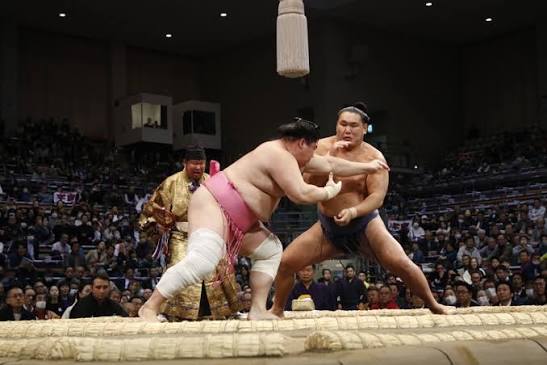
Timing is everything
Picking your basho day like a local
| Days | Character | Book if |
|---|---|---|
| 1–2 (opening weekend) | Ceremony-rich, festive, busy | You want opening-day energy and don't mind crowds |
| 3–6 (first midweek) Best value | Thinnest crowds, easiest tickets, relaxed photography | You want space, photos and the purest visit |
| 7–8 (middle weekend) | Full house, standings taking shape | Weekends are your only option — book early |
| 9–12 | Contenders separate from the pack | You follow the standings and want stakes without sell-outs |
| 13–15 (final stretch) | Championship maths, zabuton tension, senshūraku ceremony | You want drama and booked well in advance |
Insider habit: whichever day you hold, arrive by 14:00. Both dohyō-iri ceremonies, the yokozuna ritual and the entire top-division card fit in one four-hour window — the highlight reel of the whole day. Full timetable on the schedule page.
Days 13–15 vanish first. Every year.
If the final-weekend drama is what you're here for, this is the booking to make months out, not weeks.
Getting in
Basho tickets: the short version
The full mechanics live on our tournament tickets page; the essentials:
- Official channels (Ticket Oosumo, convenience stores, box office) open about a month out, Japanese-first, cheapest raw prices — from roughly ¥3,500–4,000 same-day to ~¥5,000–10,000 reserved chairs, boxes above (official figures; verify seasonally).
- The guided package bundles an S/A-class seat, English-speaking sumo expert, banzuke sheet and chanko meal — bookable in English on a live calendar, with separate allocation that often survives official sell-outs. Non-refundable; fix dates first.
- Same-day gamble: unreserved upper-tier seats sell at the venue each morning — the classic budget entry, workable on weekdays, a dawn queue on weekends.
Etiquette in the stands
- Cheer names, not "boo" — supporting your favourite loudly is welcome; jeering isn't done.
- Move to and from seats between bouts, not during shikiri.
- No flash, ever. Cushion-throwing after upsets: officially prohibited, culturally inevitable, don't start it.
- Wrestlers walk the public corridors to the ring — stand aside, enjoy the closeness, skip the shoulder-pat.
FAQ
Basho questions, answered
What does "basho" mean?
Literally "place"; in sumo it means an official 15-day Grand Sumo Tournament (honbasho). Six run per year, and November's Kyushu Basho in Fukuoka closes the season.
How is the winner decided?
Best win-loss record in the top division over 15 days takes the championship (yūshō) and the Emperor's Cup. Ties go to a playoff on the final day.
Will I see yokozuna wrestle?
Yes — barring injury withdrawal, every top-division wrestler including yokozuna fights daily, in the last hour of the card (roughly 17:00–18:00).
Is one afternoon enough?
Comfortably. 14:00–18:00 captures both ring-entering ceremonies and the entire top division. Arrive at 8:45 only if you're the completist type — it's nine hours of sumo.
Can I attend more than one day?
Yes, each day needs its own ticket. Enthusiasts often pair a cheap weekday (explore freely) with a premium final-stretch seat (drama).
What's the difference between this page and the tournament tickets page?
This page explains the basho itself — structure, rituals, day choice. The tournament tickets page handles the buying mechanics: channels, prices, packages and booking steps.
Now you speak basho
Structure understood, day chosen — all that's left is a seat with your name on it.