Quick summary
The venue at a glance
| Question | Answer |
|---|---|
| Address | 2-2 Chikko Honmachi, Hakata-ku, Fukuoka 812-0021 |
| Sumo dates | 15 days each November (2026: Nov 8–22, per the JSA calendar) |
| Hours on basho days | Doors ~8:45 → final bout ~18:00 (full timetable) |
| Tickets from | ~¥3,500–4,000 same-day upper tier (official channels); packages priced separately |
| Nearest station | Gofukumachi (subway Hakozaki Line), 10–12 min on foot |
| Time to allow | Minimum 3–4 hours; the full day rewards it |
A point of honest orientation: the Kokusai Center is a working convention hall, not a purpose-built sumo shrine like Tokyo's Ryōgoku Kokugikan. Most of the year it hosts trade fairs and volleyball. Then November arrives, the Japan Sumo Association trucks in the clay, builds the dohyō by hand, hangs the Shinto-style tsuriyane roof — and for 15 days it out-atmospheres almost any venue in Japanese sport. The compactness that makes it modest as an arena makes it superb for sumo: you're simply closer than the Kokugikan's upper bowl ever gets you.
Seating decoded
How the seating bowl works — and which seats to pick
Sumo seating is its own vocabulary. From the clay outward:
- Tamari-seki (ringside cushions). The floor cushions surrounding the dohyō itself. Thrilling and genuinely risky — wrestlers weighing 150 kg do land on spectators. No food, drink, phones-out photography or children; sold in tiny quantities and snapped up instantly.
- Masu-seki (box seats). The flat-floor tatami boxes for four, the classic postcard view of sumo attendance. Shoes off, cushions down, bento open. Atmospheric and social, but four adults in one box is cosy and knees pay the toll by hour six.
- Arena chairs (S / A / B / C). Western-style seats rising around the bowl — the purple rows in our photo. S-class sits lowest and closest; the grades climb backward and upward. This is where we point most first-timers: comfort for a nine-hour day, clear sightlines from every grade, and the price ladder is honest.
- Same-day unreserved (top tier). The budget rows at the very top, sold at the venue on the morning. Bring a jacket, arrive early on weekends, and enjoy the best value-per-yen in Japanese sport.
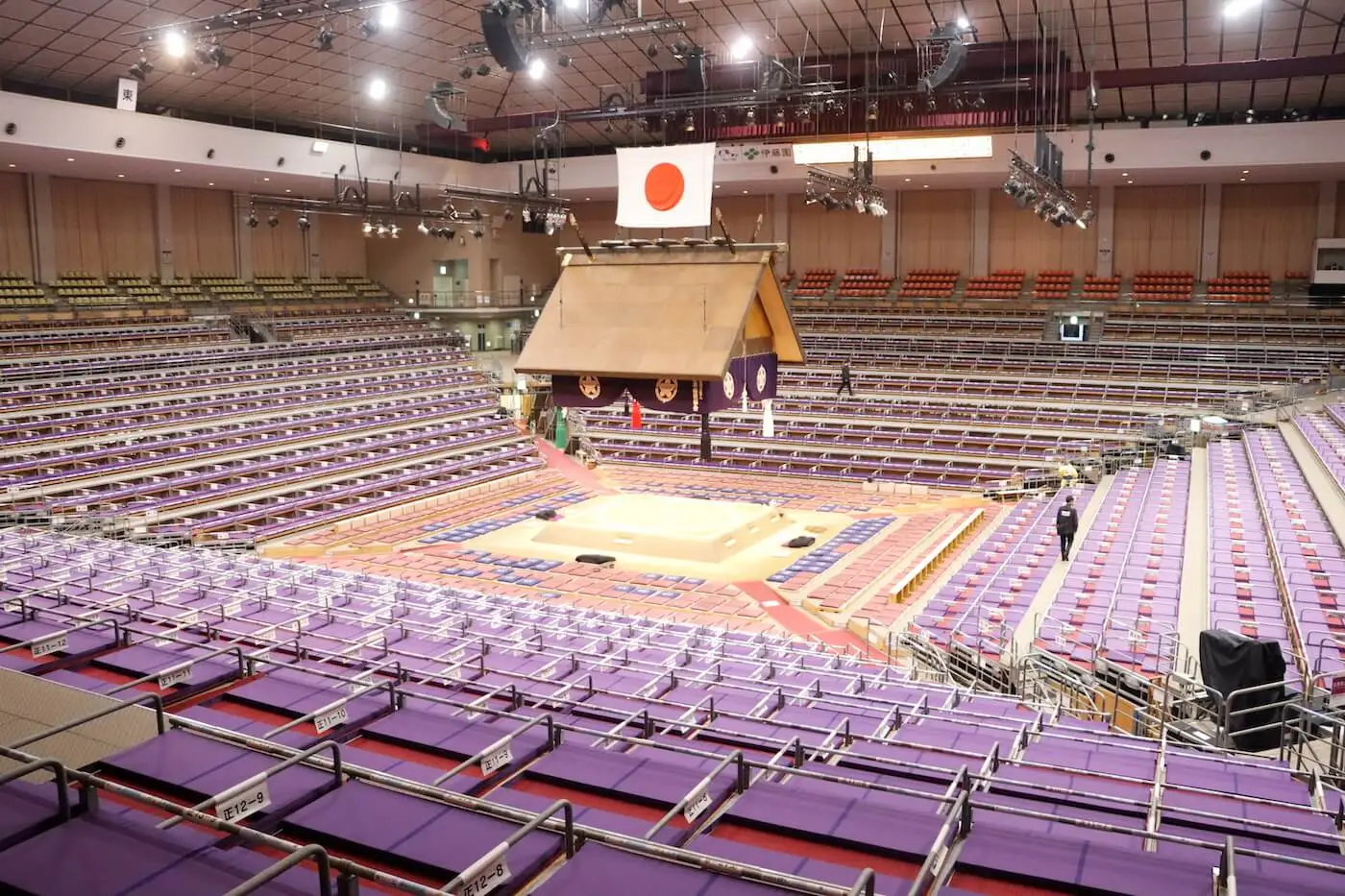
Which side? The shōmen (main/north) side faces the gyōji referee head-on and frames the classic TV angle. Seats on the east and west flanks watch bouts side-on — arguably better for seeing throws develop. If you're choosing chairs in the same class, side placement matters less than row height: lower always wins.
Booking-wise you have two roads: official channels (Japanese-first, on sale about a month out — our basho guide walks through it) or an English-language guided tournament package that bundles an S/A chair with an expert guide and a chanko meal.
How to get there
Access from Hakata Station and beyond
- Subway: ride the Hakozaki Line to Gofukumachi (one stop pattern from Nakasu-Kawabata interchange), then walk 10–12 minutes north toward the waterfront. Signage sprouts everywhere during the basho — follow the crowds in happi coats.
- Bus: Nishitetsu routes from Hakata Station (about 10–15 minutes) and Tenjin stop at Kokusai Center Sunpalace-mae, at the arena's doorstep. Grab an IC card (Suica/nimoca work interchangeably) and tap on.
- Taxi: ~10 minutes / short fare from Hakata Station. After the final bout, walk a block inland before hailing — the rank outside drains slowly at 18:00.
- On foot: 25–30 flat minutes from Hakata Station through the old port district. November in Fukuoka averages 12–17°C and mostly dry — a genuinely pleasant approach.
- From the airport: Fukuoka Airport is two subway stops from Hakata — you can land at noon and make the 15:40 dohyō-iri comfortably.
Around the arena: Bayside Place Hakata's food stalls sit ten minutes east; Kushida Shrine and the Kawabata shopping arcade line the walk back to town — pair them with dinner using our sumo & dinner guide.
Inside on basho days
Food, souvenirs, rules and practicalities
Eating and drinking
Tournament days bring bento stalls, yakitori-and-beer counters and soft-serve to the concourses. Eating at your seat is not just tolerated, it's the culture — a beer and bento during the jūryō bouts is half the point of the box seat. Stall lineups change yearly; queues peak between the two ring-entering ceremonies, so shop before 14:00.
Souvenirs worth the suitcase space
Official goods stands sell wrestler tenugui towels, banzuke ranking sheets (printed in beautiful sumo calligraphy — ¥100-cheap and frame-worthy) and the seasonal championship merchandise. If a yokozuna clinches the Emperor's Cup on your day, commemorative stock evaporates in minutes.
House rules that actually matter
- No large luggage at seats — use lockers at Hakata Station; on-site storage is minimal.
- Flash photography is prohibited; regular photography from your seat is fine everywhere except tamari rules.
- Don't throw cushions, even when everyone else does after a yokozuna upset. (Officially. What you witness on day 14 is between the crowd and the gods.)
- Accessibility: wheelchair spaces exist but are limited — arrange through the organiser in advance rather than on the day.
Seats at the Kokusai Center, sorted in English
The guided tournament package books S/A-class chairs with an English-speaking sumo expert — the whole Japanese-ticketing maze, skipped.
FAQ
Fukuoka Kokusai Center — quick answers
Where exactly is the arena?
2-2 Chikko Honmachi, Hakata Ward — on the waterfront 2 km north of Hakata Station. Gofukumachi subway station is the closest stop.
Which seats are best for a first visit?
S- or A-class arena chairs: low enough to see expressions and salt-throws, comfortable enough for a full day. Box seats for atmosphere with a group; same-day upper tier for budget.
Is there sumo at the Kokusai Center outside November?
No — professional sumo visits Fukuoka only for the November basho. The rest of the year, book a sumo experience show instead.
Can I buy food inside?
Yes, bento, snacks and drinks are sold on basho days, and eating at your seat is standard practice.
Is the arena accessible?
There are accessible routes and limited wheelchair spaces; contact the organiser ahead of your visit to arrange them — capacity is genuinely constrained.
What's the capacity?
Roughly 10,000 in sumo configuration — less than half of Tokyo's Kokugikan, which is exactly why the atmosphere concentrates so well.
See sumo — in November or any month
Tournament seats for the basho, or a year-round show with dinner included. Both book in English in minutes.